
From CAD to Production: Partnering for Faster, More Reliable Casting
May 18, 2026
Handing over a finalized CAD file to a manufacturing supplier is a moment of distinct anxiety for engineering leaders. You have spent months carefully calculating structural loads and optimizing complex geometries on a screen. Now you must trust an outside vendor to translate that digital perfection into a reliable physical component.
Working with a transactional supplier amplifies this risk. An order-taker simply casts exactly to the print provided. If your design contains a hidden manufacturability flaw, a transactional vendor will permanently build that exact flaw into the final metal part.
Any savings achieved by accepting the lowest bid are quickly wiped out by the escalating costs of scrapped production runs, material waste, and frustrating delays.
Texas Precision Metalcraft approaches manufacturing entirely differently. We act as an extension of your engineering and product development departments. Our team guides you through the entire casting process, bridging the gap between digital concepts and flawless physical outcomes.
Phase One: Proactive Manufacturability Review
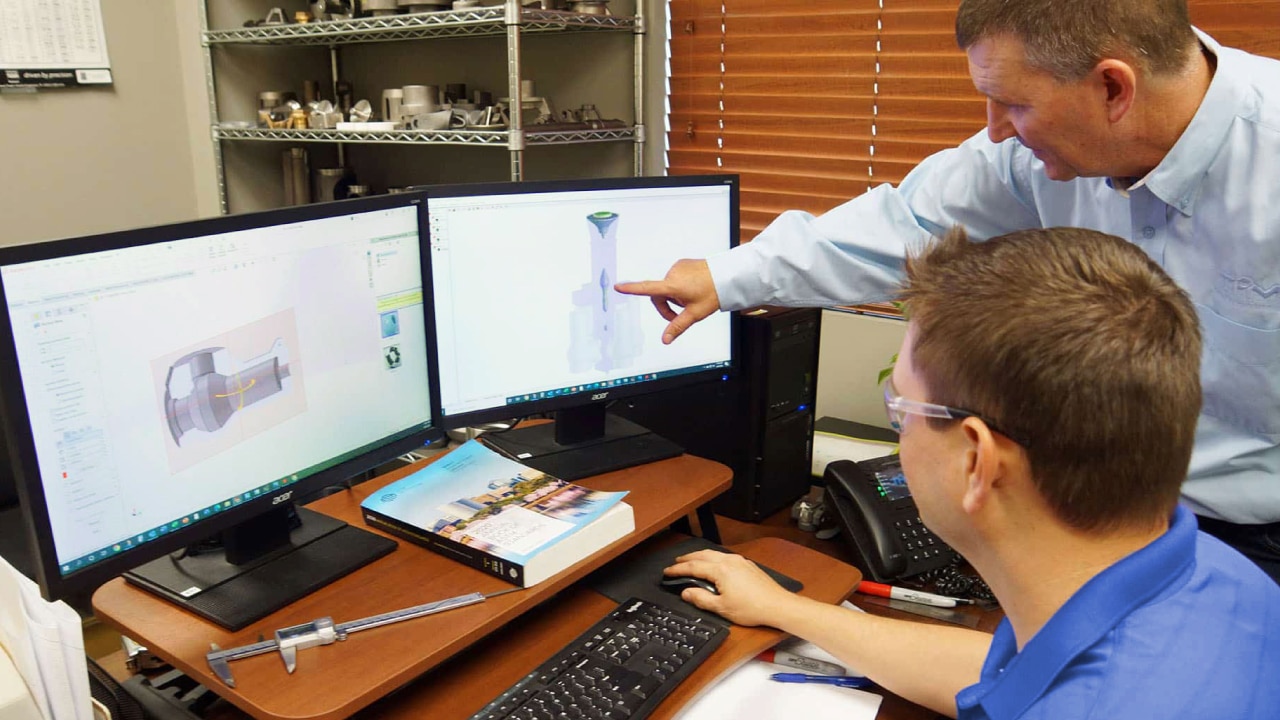
A faster production timeline begins long before any physical tooling is cut. Our process starts with a consultative and collaborative engineering analysis. TPM experts sit down with your team to thoroughly understand your specific application, the operating environments the part must survive, and your performance requirements.
We review your digital models to identify potential friction points in the manufacturing process. This proactive review focuses on several key areas of optimization:
- Strategic tolerance mapping: We help your team identify where extreme precision is truly necessary. Leaving non-critical areas with a high-quality as-cast finish allows you to reserve costly CNC machining strictly for critical mating surfaces and threaded holes.
- Part consolidation analysis: We look for opportunities to merge multi-part assemblies into a single unified casting. This strategic move eliminates downstream welding operations and removes vulnerable mechanical fasteners from your design.
- Geometric refinement: We may recommend subtle adjustments to corner radii and wall thickness transitions. Smoothing these areas prevents dangerous stress concentrations from forming during the rapid cooling process.
Phase Two: Virtual Validation and Metallurgical Analysis
Every metal alloy behaves differently when transitioning from a molten liquid to a solid state. Matching the specific geometric demands of your CAD file with the unique thermal properties of your chosen alloy is critical for success.
TPM utilizes advanced solidification simulation software to run highly accurate virtual pours. This technology allows us to observe exactly how the molten metal will flow into the ceramic mold cavity and predict where the metal might cool too quickly. We can also identify potential hot spots that lead to subsurface porosity.
Resolving these uneven cooling rates in a virtual environment allows us to optimize gate placements and feeding systems immediately. Our team works closely with your leadership to eliminate the expensive guesswork of trial-and-error physical casting.
Phase Three: Precision Tooling and Physical Validation
Once the virtual model is fully validated, we begin creating the physical pieces that will be used to create your component. Our tooling engineers machine aluminum wax injection dies to capture the negative geometry of your component.
We then produce the initial physical prototypes. This crucial phase allows us to prove out the automated ceramic shell building process and confirm the exact volumetric shrinkage rates of your chosen metal.
Reviewing these initial physical samples gives your team absolute confidence. You know definitively that your geometry is fully optimized for the investment casting process before you commit to a larger production run.
Phase Four: Scaling to Production with Repeatable Precision
Transitioning from a validated prototype into full-scale production should never introduce new variables. Because we lock down every specific parameter during the first three phases, scaling up your volume becomes a completely seamless process.
TPM builds strict quality control directly into the manufacturing cycle. We utilize automated dipping processes to ensure the ceramic mold thickness remains perfectly uniform pour after pour. We strictly monitor wax injection temperatures and metal pouring conditions.
This unwavering consistency maintains exceptionally tight tolerances and pristine surface finishes across thousands of cycles. You can trust that the ten-thousandth part will perfectly match the exact specifications of your approved prototype.
Securing Confidence Before Production Begins
Achieving a faster and more reliable casting process is never an accident. It requires deliberate alignment between your design engineers and your manufacturing partner from day one.
Texas Precision Metalcraft delivers exactly that level of dedicated expertise. We help you eliminate friction, reduce manufacturing risks, and accelerate your timeline to market.
Let us show you what a true manufacturing partnership looks like in practice. Schedule a consultation with our engineering experts today to discuss the unique requirements of your next complex component.