
How to Choose the Right Casting Method for Producing Complex Parts
May 18, 2026
Imagine engineering a high-pressure fluid manifold for an industrial chemical application. The design features converging internal cooling channels. It requires a highly corrosion-resistant steel alloy to survive harsh environments. Procurement reviews the bids and selects a manufacturing method based entirely on the lowest upfront tooling cost.
Several weeks later, the physical parts arrive on the machine shop floor. The rough metal requires hours of aggressive milling just to reach basic dimensional accuracy. Hidden microscopic air pockets beneath the surface ruin one out of every five parts during the final threading operations. Your launch timeline slips by an entire month.
The initial savings vanish completely. Hidden downstream costs eat away at your margins.
Engineering and operations leaders face a constant balancing act. You must constantly weigh part performance against geometric complexity and total production cost. Choosing the correct manufacturing method requires looking far beyond the initial tooling quote. You must evaluate the entire lifecycle cost of the component to make a truly data-driven decision.
Evaluating Different Casting Process
Texas Precision Metalcraft operates as a consultative partner across a wide spectrum of casting capabilities. We work closely with our clients to determine the exact manufacturing method best suited for their specific application. Understanding the physical limitations of each process is the crucial first step in avoiding costly downstream redesigns.
Evaluating your options requires a clear understanding of what each process delivers.
Sand Casting
Sand casting involves packing sand around a master pattern to create a disposable mold. It remains one of the oldest and most traditional metalworking techniques available today.
- Massive components: This method excels at producing extremely large parts or low-volume runs where heavy tooling investments do not make financial sense.
- Lower upfront costs: The initial patterns are relatively inexpensive and fast to produce.
- Rougher surface finishes: The grainy nature of the sand leaves a heavily textured exterior that often requires significant downstream smoothing.
- Limited dimensional accuracy: The process inherently yields looser tolerances, making intricate features and highly specific geometries difficult to achieve.
- Complex internal voids: Creating internal passages requires fragile sand core assemblies that add risk, labor, and potential failure points.
Die Casting / Permanent Mold
Die casting and permanent mold processes force molten metal into reusable hardened steel molds under high pressure or gravity. This method is often favored for rapid, high-volume production cycles. However, it is critical to note that these two processes are exclusively suited for aluminum and zinc.
- Rapid production speed: The process delivers rapid cycle times that are useful for scaling up to tens of thousands of units.
- Consistent surface quality: It produces a clean, smooth finish out of the mold with relatively strong precision.
- Strict material limitations: Since the process is heavily restricted to lower-melting-point non-ferrous metal (aluminum and zinc), you cannot use high-strength steel alloys.
- High initial tooling costs: Cutting hardened steel molds requires a massive upfront investment that only pays off at extreme volumes.
- Inflexible design changes: Once the expensive tooling is cut, modifying the physical design is both incredibly difficult and costly.
Investment Casting
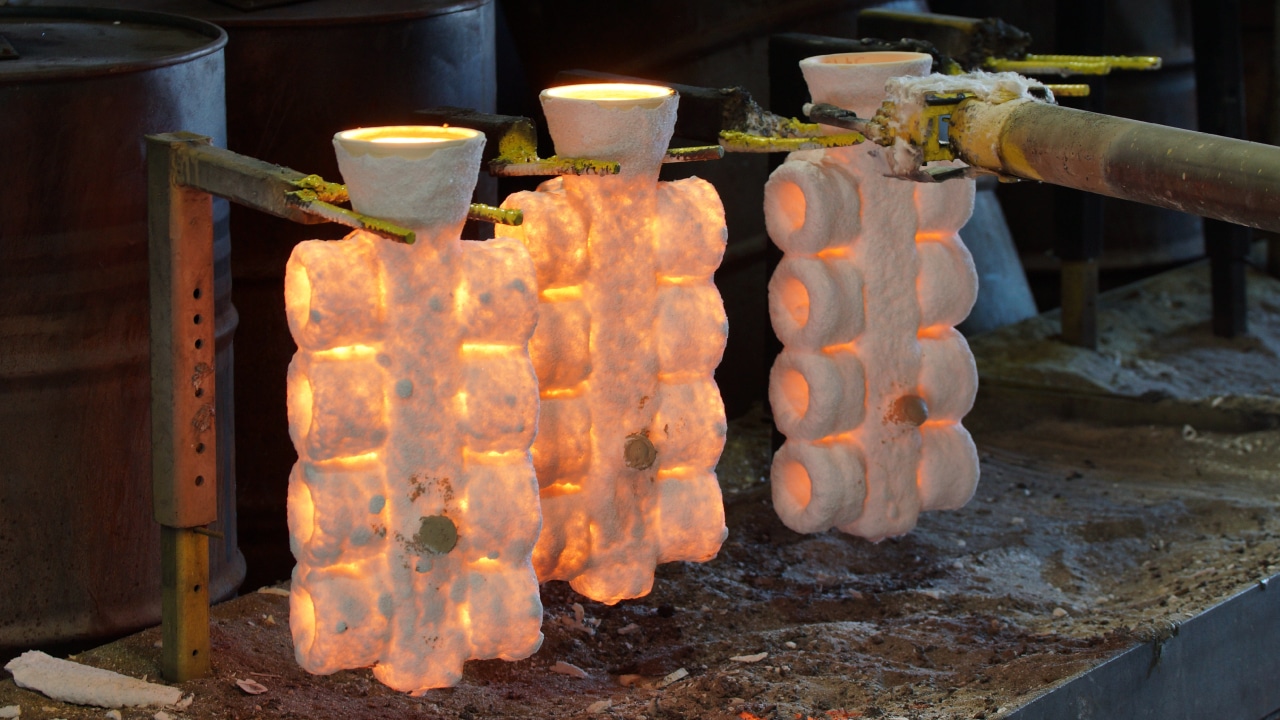
Investment casting involves dipping a highly accurate wax pattern into a ceramic slurry to build a disposable mold. The wax is then melted away, leaving a perfect cavity for the final molten metal.
- Unmatched design freedom: This method effortlessly handles highly intricate internal passages, severe undercuts, and extremely thin walls down to two millimeters.
- Exceptional dimensional accuracy: The process delivers a part that closely matches its final intended dimensions, drastically reducing the need for secondary machining.
- Broad material versatility: Engineers can choose from a nearly unlimited range of ferrous and non-ferrous alloys, including high-performance steels and exotic metals.
- Superior surface finishes: The fine ceramic shell creates a remarkably smooth exterior right out of the mold, eliminating heavy polishing steps.
- Part consolidation: The extreme precision gives engineers the freedom to combine multiple smaller components into a single cast part, reducing assembly time and failure points.
The Total Cost of Ownership Equation
The upfront cost of tooling often creates a dangerous illusion of affordability. A cheap sand casting pattern saves your budget on day one. Machining six or seven different surfaces to achieve acceptable tolerances will completely destroy that same budget by day thirty.
Excessive secondary processing adds massive labor expenses and extends your lead times exponentially. Scrap rates climb rapidly when internal defects are uncovered deep into the machining process.
Investment casting carries moderate initial tooling and labor costs due to the creation of precise wax injection dies and sacrificial ceramic shells. However, this initial investment pays massive dividends during actual production.
Achieving tight tolerances straight from the mold eliminates significant downstream machining, tedious surface finishing, and excessive material waste. Evaluating the total finished cost consistently proves that investment casting becomes the most cost-effective choice for intricate parts. This break-even reality holds true even at low to medium production volumes.
Hybrid Manufacturing: Investment Casting and Machining Combined
Manufacturing strategies do not have to be an exclusive choice between casting and machining. Achieving the ultimate balance of cost and extreme precision often requires a strategic hybrid approach.
A cast-first methodology can deliver exceptional results in certain cases. Engineers utilize custom investment casting to rapidly and affordably produce a blank part that closely matches the final design. This initial step creates a component with 95% of the finished geometry.
CNC machining is then applied to highly critical mating surfaces or extremely tight-tolerance threaded holes. Starting with an investment cast blank means the cost of CNC machining is dramatically decreased. Spindle cycle times also drop significantly because the bulk of the material is already absent. You practically eliminate the wasted stock associated with machining a complex part entirely from a solid metal block.
Secure the Right Specifications Early
Matching the right process to your component requires evaluating the entire lifecycle of the part. You have to anticipate how early manufacturing decisions impact downstream finishing, assembly, and field performance.
Texas Precision Metalcraft helps engineering teams run exact cost and complexity models to ensure they lock in the right specifications early. We collaborate closely to eliminate hidden expenses and protect your final margins.
Schedule a consultation today to see how our collaborative engineering experts can optimize your next complex manufacturing project.