
Lost Wax vs. Investment Casting: What is the Real Difference?
July 16, 2026
If you are exploring manufacturing options for complex metal parts, you have likely encountered two very specific terms. You might see one supplier refer to their services as the lost wax casting process while another promotes their state-of-the-art investment casting capabilities. This often leads to a common question for engineers and procurement managers. When comparing lost wax and investment casting, which one is the right choice for your project?
The short answer is that they are technically the same thing. The difference lies mostly in history and application rather than the mechanics of the manufacturing itself. While the term “lost wax” nods to the ancient roots of the technique, “investment casting” is the modern industrial name for the high-precision method we use today. Understanding this relationship helps you navigate precision casting terminology with confidence and ensures you find the right partner for your production needs.
From Ancient Art to Modern Industry
The confusion between these two terms is understandable because they describe identical physical actions. The process involves creating a pattern, coating it in a refractory material, melting the pattern away, and pouring molten metal into the void.
The term “lost wax” (or cire perdue in French) has been used for thousands of years. It historically refers to creating jewelry, statues, and art. It highlights the fact that the wax pattern is “lost” or destroyed during the creation of the mold.
In the mid-20th century, the demand for complex aerospace and industrial components grew rapidly. Engineers needed a term that sounded less like an art project and more like a controlled industrial science. The term “investment casting” was adopted. It refers to the act of “investing” (surrounding or enveloping) the wax pattern with a ceramic slurry.
Today, when you hear lost wax vs. investment casting being debated in a boardroom, the conversation is usually about the same high-quality results. However, “investment casting” almost always implies the use of advanced alloys and tight engineering tolerances.
How the Investment Casting Process Works
Whether you call it lost wax or investment casting, the steps to create a part remain consistent. This method is favored because it produces near-net-shape parts that require very little machining.
Here is how we turn a design into a finished metal component at Texas Precision Metalcraft:
- Pattern Creation: We start by injecting wax into a metal die to create an exact replica of the final part.
- Assembly: These wax patterns are attached to a central wax “sprue” to create a tree-like assembly.
- Shell Building: We dip the entire wax tree into a ceramic slurry and coat it with fine sand. This happens multiple times to build a hard shell.
- Dewaxing: The ceramic shell is heated. This melts the wax out of the mold and leaves a perfect hollow cavity.
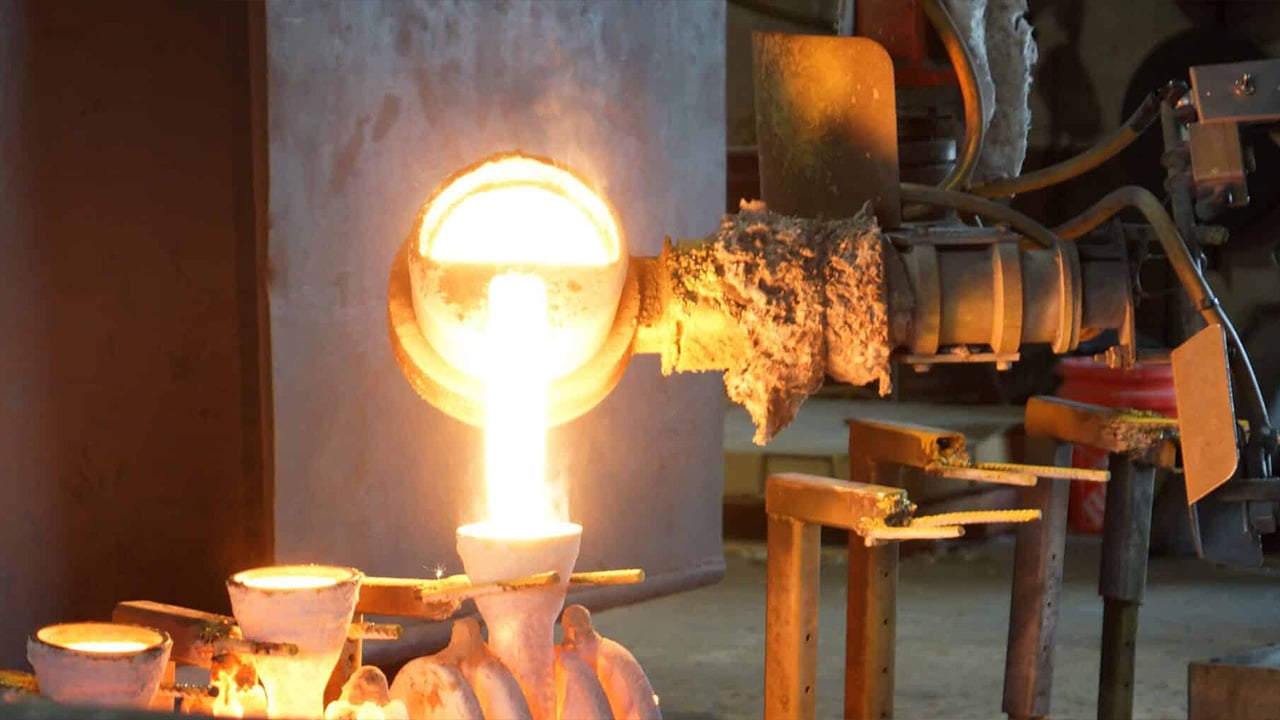
- Pouring: We preheat the ceramic shell and pour molten metal into it. The metal fills every detail left by the evacuated wax.
- Knockout: Once the metal cools and solidifies, the ceramic shell is broken and vibrated away to reveal the metal parts.
- Finishing: The parts are cut from the sprue and ground or machined to meet final specifications.
Why Choose This Method for Manufacturing?
Now that we have clarified the casting terminology, it is important to understand why this process is a staple in industries ranging from aerospace to food processing. The benefits of investment casting are numerous for projects that demand accuracy and durability.
The primary advantage is geometric freedom. Because the mold is created from a liquid slurry that hardens around a pattern, you can create undercuts, thin walls, and intricate internal passageways that are impossible with other methods. You do not have to worry about “draft angles” in the same way you do with sand casting.
Another major benefit of modern investment casting techniques is a surface finish that is much smoother than what is achieved through sand casting or forging. This reduces the need for expensive secondary machining operations. You get a part that looks professional and functions perfectly right out of the mold. This efficiency makes it a cost-effective choice for medium to high-volume production runs where consistency is key.
Finding the Right Partner
Understanding the nuance of lost wax vs. investment casting is just the first step. The most important decision is choosing a foundry that understands your specific requirements. You need a partner who can guide you through alloy selection and design optimization to get the most out of this versatile process.
At Texas Precision Metalcraft, we combine the artistry of traditional methods with the rigor of modern industrial standards. We are ready to help you move your project from a concept on a screen to a precision metal part in your hands.