
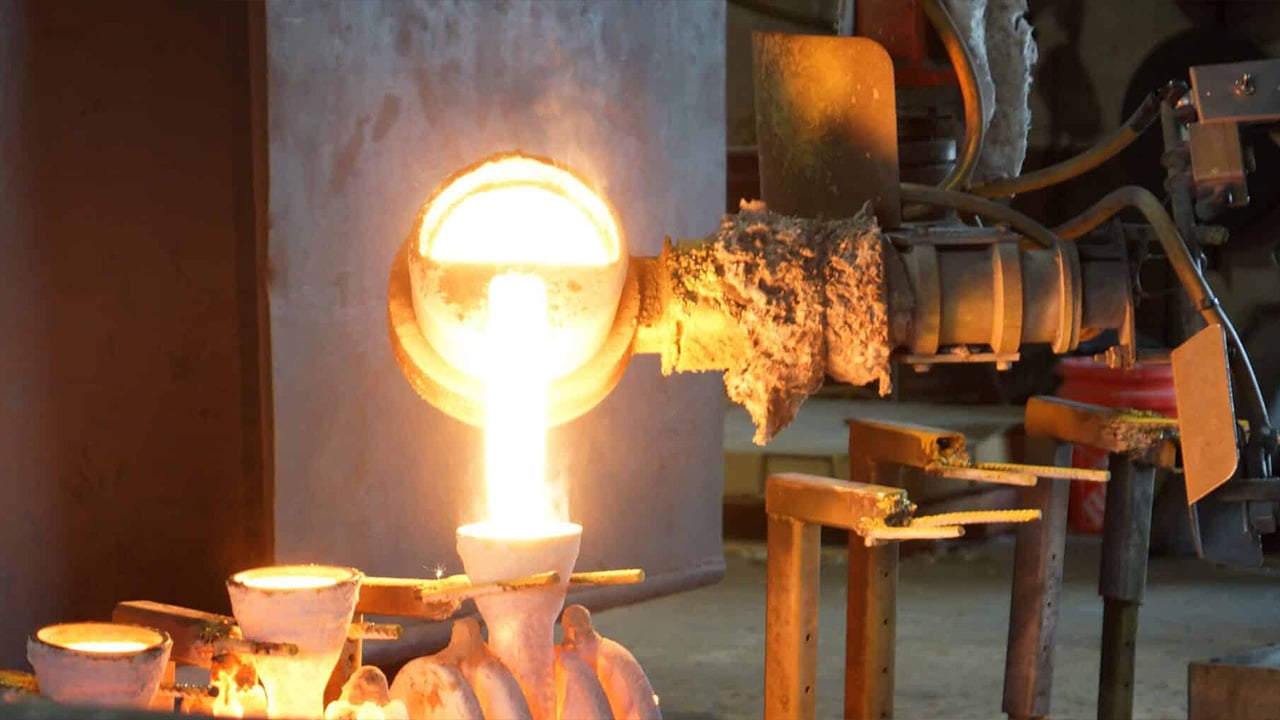
What Type of Casting is Right for You?
January 19, 2026
Choosing the optimal casting or manufacturing process can make the difference between a successful part and unnecessary cost, delays, or performance issues. Even experienced engineers sometimes face trade-offs when deciding between investment casting, die casting, sand casting, CNC machining, additive manufacturing, or forging.
The right choice comes down to understanding the part’s complexity, material requirements, tolerances, production volume, and performance expectations.
How to Evaluate Your Options
Investment Casting
Best for complex geometries that require tight tolerances and fine surface detail, investment casting supports a broad range of metals—including steels, stainless alloys, titanium, and superalloys. It balances design flexibility, precision, and material versatility, making it a go-to for aerospace fittings, medical components, turbine blades, and critical valve or pump parts. Lead times are moderate, and tooling costs are reasonable for low-to-medium volume production.
Die Casting
Die casting is ideal for high-volume non-ferrous parts such as housings, brackets, and covers. It offers excellent surface finish and good dimensional control, but with less design flexibility than investment casting. Initial tooling investment is high and tools have a very limited life with high replacement costs, but unit costs drop significantly at volume.
Sand Casting
When size and cost are primary considerations, sand casting provides a low-cost solution for medium-to-large parts. Accuracy and surface finish are lower, but the process accommodates very large components and a wide range of alloys, making it suitable for industrial equipment, pump housings, and engine blocks.
CNC Machining
CNC machining remains the benchmark for ultra-tight tolerances and superior surface finish. While part geometries are often simpler than those in casting, machining excels for high-precision components, tooling, and fixtures where accuracy is paramount.
Metal 3D Printing (Additive Manufacturing)
Additive manufacturing allows rapid iteration of complex shapes at low volumes. While unit cost is higher, the design freedom is unmatched, supporting lattice structures, lightweight components, and prototypes that are difficult or impossible with traditional methods. Material options are more limited than casting or machining.
Forging + Machining
For components where strength, fatigue resistance, and load-bearing capability are critical, forging combined with machining is unmatched. Applications include gears, shafts, connecting rods, and other structural parts. While tooling and per-part cost are higher, the mechanical properties justify the investment for high-performance applications.
Comparative Overview
| Factor | Investment Casting | Die Casting | Sand Casting | CNC Machining | Metal 3D Printing | Forging + Machining |
|---|---|---|---|---|---|---|
|
Best For
|
Complex, precision parts |
High-volume non-ferrous parts |
Large, simple parts |
High-precision, low–medium volume |
Complex shapes, rapid iteration |
High-strength, load-bearing parts |
|
Geometric Complexity |
★★★★★ |
★★★☆☆ |
★★☆☆☆ |
★★★★☆ |
★★★★★ |
★★★☆☆ |
|
As-Cast/As-Built Accuracy |
High |
Moderate–High |
Low–Moderate |
Very High |
High |
High (after machining) |
|
Surface Finish |
Very good (125–250 RMS) |
Excellent |
Rough |
Excellent |
Good–Excellent |
Excellent (after machining) |
|
Typical Tolerances |
±0.005–0.010″ |
±0.002–0.005″ |
±0.010–0.030″ |
±0.0005–0.002″ |
±0.002–0.005″ |
±0.0005–0.002″ |
|
Material Options |
Broad (steels, superalloys, Ti, Al, Cu) |
Mostly Al, Zn, Mg |
Very broad |
Very broad |
Steels, Al, Ti, Ni alloys |
Limited |
|
Part Size |
Small–medium |
Small–medium |
Medium–very large |
Small–medium |
Small–medium |
Small–large |
|
Lead Time |
Medium |
Short |
Short |
Short |
Short–Medium |
Medium |
|
Tooling Cost |
Moderate |
High |
Low–Moderate |
None |
None |
Moderate–High |
|
Unit Cost |
Medium |
Low (volume) |
Low |
High |
High |
High |
|
Volume Suitability |
Low–medium |
High |
Low–medium |
Low–medium |
Low–medium |
Medium |
|
Strength/Mechanical Properties |
Good |
Moderate |
Moderate–Good |
Excellent |
Good (varies) |
Excellent |
|
Design Flexibility |
Very high |
High |
Low–Moderate |
High |
Very high |
Low–Moderate |
|
Common Applications |
Turbine blades, aerospace fittings, medical parts |
Housings, brackets, covers |
Engine blocks, pump housings |
Precision tooling, fixtures |
Prototypes, lattice structures |
Gears, shafts, structural components |
Quick-Decision Guide
- Maximum complexity + good accuracy + broad material choice → Investment Casting
- Lowest per-part cost at high volumes → Die Casting
- Very large or simple, low-cost parts → Sand Casting
- Ultra-tight tolerances + superior surface finish → CNC Machining
- Complex shapes quickly at low volume → Metal 3D Printing
- Highest strength and fatigue performance → Forging + Machining
While we hope this guide is helpful in determining the right casting method for your project, there is always nuance, and a custom solution may be the best option. At Texas Precision Metalcraft, we partner with engineers to match the right process to the right application. Understanding the trade-offs between complexity, cost, and performance allows your team to make informed decisions that keep programs on schedule and parts performing as designed.
Ready to get started on your next casting project?
Contact us today, and we’ll get things moving for a quick turnaround with advanced precision.