
Why Engineers Trust Custom Alloy Casting for Mission-Critical Parts
August 13, 2026
When a component failure means a shut-down assembly line, a chemical leak, or a grounded aircraft, there is no room for error in the manufacturing process. Engineers and procurement managers face immense pressure to source parts that can withstand extreme environments without compromising on cost or lead time. This is why many professionals turn to custom alloy casting to solve their most complex manufacturing challenges.
This process offers a level of precision and material control that methods like welding or machining often cannot match. It allows designers to create parts that are specifically engineered for their intended environment rather than adapting a design to fit the limitations of stock materials.
Achieving Superior Strength with High-Performance Metal Alloys
The primary reason engineers specify casting for critical applications is material versatility. Off-the-shelf bar stock or plate metal limits you to standard grades that may not offer the exact characteristics required for a specialized application.
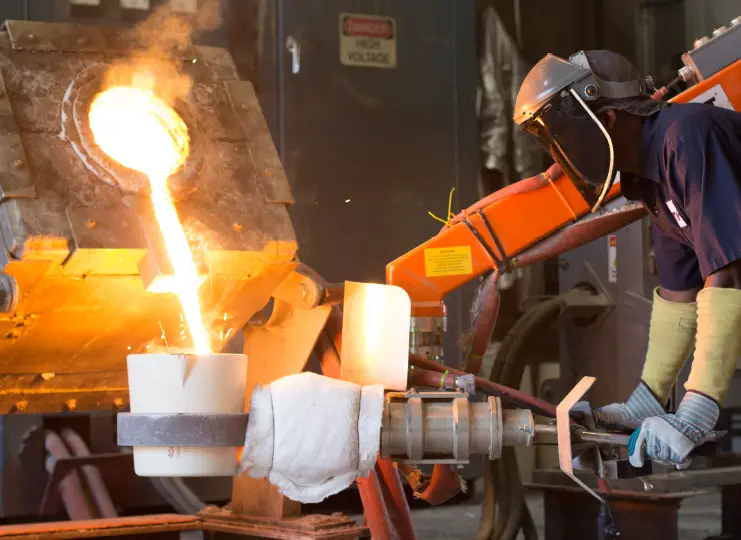
Casting allows foundries to formulate high-performance metal alloys tailored to specific operational demands. This metallurgical freedom ensures the final component has the exact chemical composition needed to survive its service life.
Engineers choose this method when they need to control specific variables:
- Corrosion Resistance: Creating alloys that withstand exposure to saltwater, acids, or caustic cleaning agents.
- Heat Tolerance: Formulating metals that maintain structural integrity inside turbines or exhaust systems.
- Wear Resistance: Increasing hardness to prevent degradation in high-friction machinery.
By adjusting the metallurgy at the start of the process, manufacturers avoid the need for expensive secondary coatings or treatments later.
Reducing Points of Failure in Aerospace Designs
In sectors like aviation and defense, weight reduction and structural integrity are competing goals. Traditional manufacturing often involves welding multiple machined parts together to create a complex assembly. Every weld seam represents a potential weak point that requires rigorous inspection and certification.
Aerospace investment casting solves this problem by allowing engineers to consolidate multiple parts into a single, monolithic component. The investment casting process can replicate intricate geometries, thin walls, and internal passageways that would be impossible to machine from a solid block.
Transitioning to a single cast piece offers several engineering advantages:
- Weight Reduction: Excess material is eliminated from the design, which is critical for fuel efficiency.
- Leak Prevention: Removing joints and seals eliminates pathways for fluids or gases to escape.
- Improved Fatigue Life: A continuous grain structure distributes stress more evenly than a welded assembly.
This near-net-shape capability means the part emerges from the mold looking almost identical to the final CAD model, significantly reducing the time spent on secondary machining.
Casting Material Properties: Ensuring Predictability
Reliability is data-driven. Engineers need to know that the thousandth part coming off the line will perform exactly like the first. The science behind casting material properties provides this assurance.
Modern foundries use advanced solidification modeling and process controls to dictate how the metal cools and forms its grain structure. This control results in isotropic properties, meaning the metal has equal strength in all directions. This is a distinct advantage over forgings or rolled steel, which often have directional weakness due to the grain flow created during processing.
Stakeholders in the defense, energy, aerospace, and oil and gas industries rely on this uniformity. It ensures that parts will behave predictably under thermal cycling or mechanical load.
A Partnership for Precision
Choosing the right manufacturing method is about balancing performance, cost, and risk. For components that simply cannot fail, casting provides the design freedom and metallurgical control necessary to meet strict safety standards. It transforms a digital design into a robust physical asset ready for the real world.
If you are evaluating a complex design or looking to improve the performance of an existing component, our team is ready to help you navigate the alloy selection and design process.